-
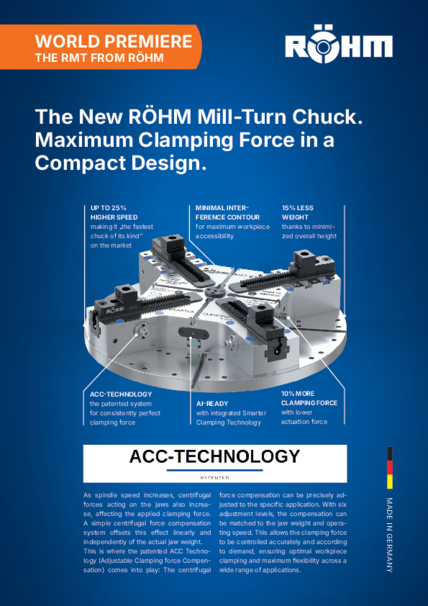
Up to 25% higher Speed
-
10% More clamping force - with lower actuation force
-
minimal interference contour - for maximum workpiece accessibility
-
15% less weight thanks to minimized overall height
-
Patented, adjustable centrifugal force compensation
-
AI-Ready with integrated Smarter Clamping Technology
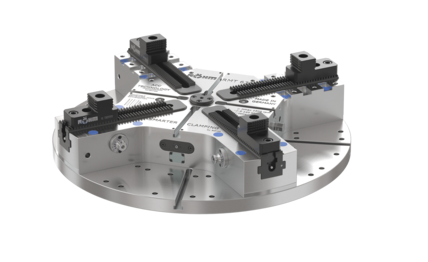
Key Performance Data RMT 630 2+2
| Size | Ø630 mm |
| Max. clamping force | 150 kN |
| Total weight without top jaws | approx. 150 kg |
| Overall height | 111 mm |
| Max. actuation torque | approx. 170 Nm |
| Max. speed | 1500 rpm |
What sets the RÖHM Mill-Turn chuck apart:
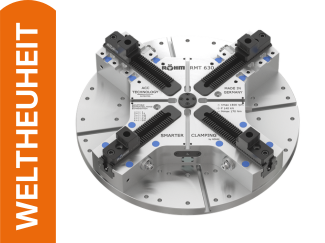
The RÖHM Mill-Turn Chuck combines a self-centering 4-jaw design with a central drive spindle, delivering maximum precision in clamping force transmission while maintaining a reduced profile height. High clamping forces provide the process reliability required for demanding machining operations and enable greater depths of cut and higher feed rates. Combined with the patented ACC Technology, featuring manually adjustable centrifugal force compensation, the clamping force can be precisely adapted to the application, workpiece, and spindle speed.
The approximately 30 mm lower profile height improves tool accessibility, increases collision clearance, and creates ideal conditions for machining close to the chuck as well as for setting up larger workpieces. As a result, even complex workpieces can often be fully machined in a single setup.
The reduced weight lowers machine load, increases available payload capacity, and improves suitability for machines with limited table load capacity. Combined with the higher clamping force, this results in a significant increase in productivity.

Patented ACC-Technology
As spindle speed increases, centrifugal forces acting on the jaws also increase, affecting the applied clamping force. A simple centrifugal force compensation system offsets this effect linearly and independently of the actual jaw weight.
This is where the patented ACC Technology (Adjustable Clamping force Compensation) comes into play: The centrifugal force compensation can be precisely adjusted to the specific application. With six adjustment levels, the compensation can be matched to the jaw weight and operating speed.
This allows the clamping force to be controlled accurately and according to demand, ensuring optimal workpiece clamping and maximum flexibility across a wide range of applications.